I Chose Liberty by Walter Block
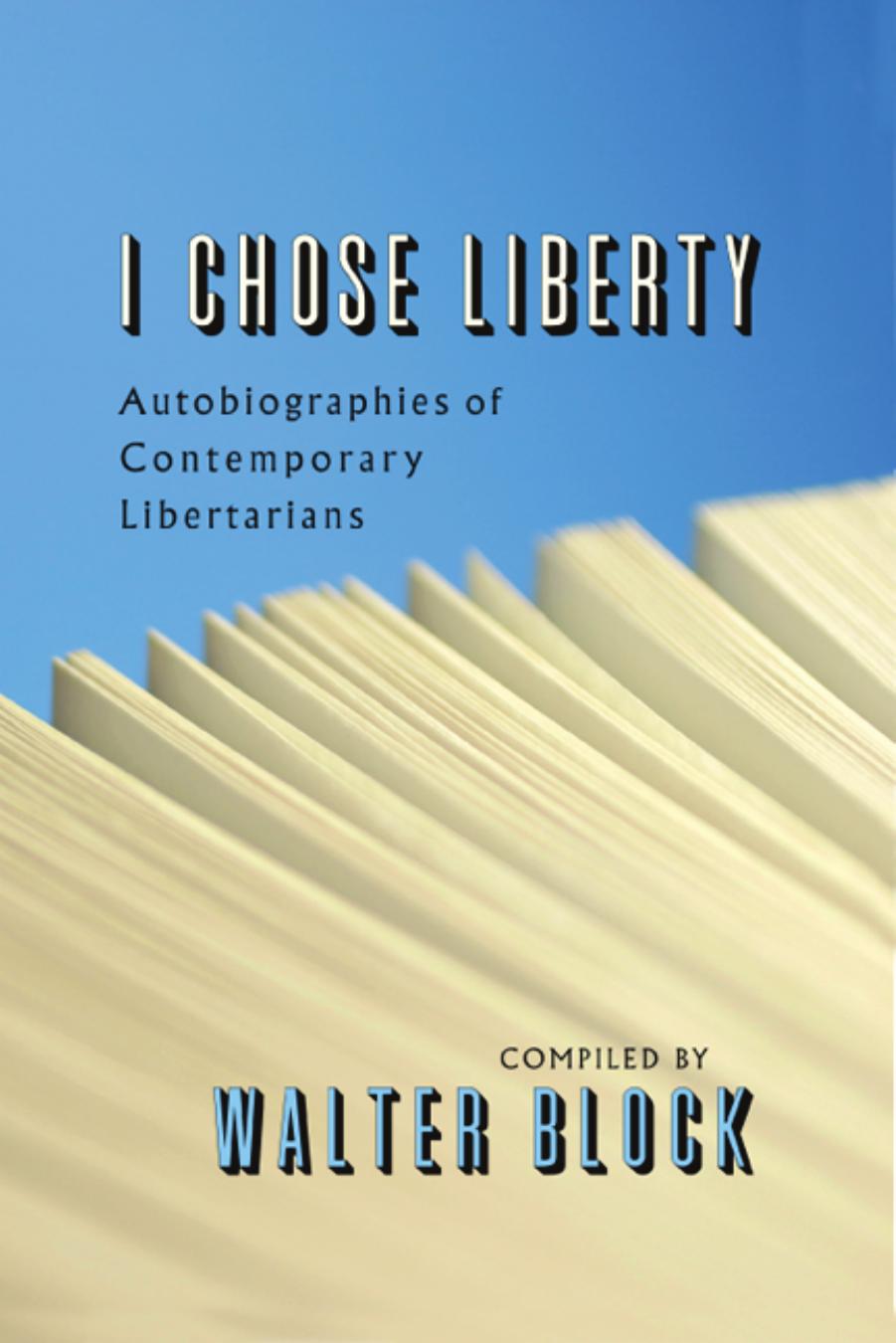
Author:Walter Block
Language: eng
Format: epub, pdf
ISBN: 9781610160025
Publisher: Ludwig von Mises Institute
Spencer Heath MacCallum was a social anthropologist and libertarian anarchist author.
46
DANIEL MCCARTHY
LIBERTARIAN IN REVERSE
IT MAY BE A BIT BOLD OF ME to submit my story for Walter Block’s libertarian autobiography series. I’m less distinguished than most of its contributors and I’m more fluent in the idiom of conservatism than that of libertarianism. But the latter really isn’t a problem; there’s little difference between a genuine American conservative and a Rothbardian libertarian. For me, there’s none at all. I’ll offer my story as proof.
As soon as I became politically aware, around the age of 13, I became a conservative. It was plain to see even at that age that the Left was crazy. More importantly, I simply didn’t subscribe to the pieties of late twentieth-century America—didn’t believe in progress, didn’t take it for granted that history always turned out for the better. I was a skeptic, and I was skeptical not of religion but of the vague concepts that nowadays stand in for religion: democracy, equality, diversity, etc.
Conservatism doesn’t mean much when you’re 13 years old. For me, it meant reading National Review, listening to talk radio (I preferred G. Gordon Liddy to Rush Limbaugh), and volunteering on the occasional Republican campaign. These activities introduced me to the Beltway brand of libertarianism. It was unobjectionable, uninspiring stuff—economic conservatism with some mental muscle. But I wasn’t interested in economics, so I wasn’t interested in libertarianism. I knew that libertarians also wanted to legalize drugs and that most, though not all, favored abortion rights, but I didn’t make the mistake of assuming that libertarians had to be libertines. Libertarianism was respectable enough, it just wasn’t for me.
My opinion of libertarianism took a turn for the worse in college, where the first libertarians I met had left a good impression—they were buttoned-down types, intelligent and easygoing—but where I soon encountered libertarians of what Murray Rothbard called the “modal” variety. These were young men—and they’re always male—with a fanatical gleam in their eyes, eager to buttonhole and evangelize, full of all the self-confidence that comes with unblinking dogmatism. They thought they had the answer to every important question in the world, when what they really had was a hormonal imbalance. What they said was not too unlike from what I’d heard before, but their attitude made all the difference. Like many a traditionalist conservative before me, seeing the intemperance in those eyes and hearing it in the pitch of their voices convinced me that libertarianism had to be as bad as Communism. These were Jacobins who would smash anything that stood in the way of creating their utopia.
An idea isn’t wrong just because it’s espoused by a few sociopaths. I knew that, but after this encounter I started to look more critically at libertarianism and at what it might imply. I found in it a lot of -isms that alarm a conservative: utilitarianism and utopianism were instantly objectionable, while rationalism and individualism could, in the wrong hands, be turned into cudgels with which to attack everything from religion to the bourgeois family.
Download
This site does not store any files on its server. We only index and link to content provided by other sites. Please contact the content providers to delete copyright contents if any and email us, we'll remove relevant links or contents immediately.
Hit Refresh by Satya Nadella(9111)
When Breath Becomes Air by Paul Kalanithi(8414)
The Girl Without a Voice by Casey Watson(7877)
A Court of Wings and Ruin by Sarah J. Maas(7798)
Do No Harm Stories of Life, Death and Brain Surgery by Henry Marsh(6928)
Shoe Dog by Phil Knight(5249)
The Rules Do Not Apply by Ariel Levy(4946)
A Higher Loyalty: Truth, Lies, and Leadership by James Comey(4942)
Hunger by Roxane Gay(4919)
Tuesdays with Morrie by Mitch Albom(4761)
Everything Happens for a Reason by Kate Bowler(4725)
The Immortal Life of Henrietta Lacks by Rebecca Skloot(4569)
Millionaire: The Philanderer, Gambler, and Duelist Who Invented Modern Finance by Janet Gleeson(4455)
How to Change Your Mind by Michael Pollan(4343)
All Creatures Great and Small by James Herriot(4299)
The Money Culture by Michael Lewis(4182)
Man and His Symbols by Carl Gustav Jung(4118)
Elon Musk by Ashlee Vance(4115)
Tokyo Vice: An American Reporter on the Police Beat in Japan by Jake Adelstein(3968)
